
America woke up to flames, sirens, and disbelief after the devastating plane crash at the regional airport in Statesville, North Carolina, a tragedy that instantly carved grief into the national conscience.
Lives were lost, families were shattered, and yet within the chaos, another story quietly began forming, unnoticed at first, moving beneath headlines and official statements.

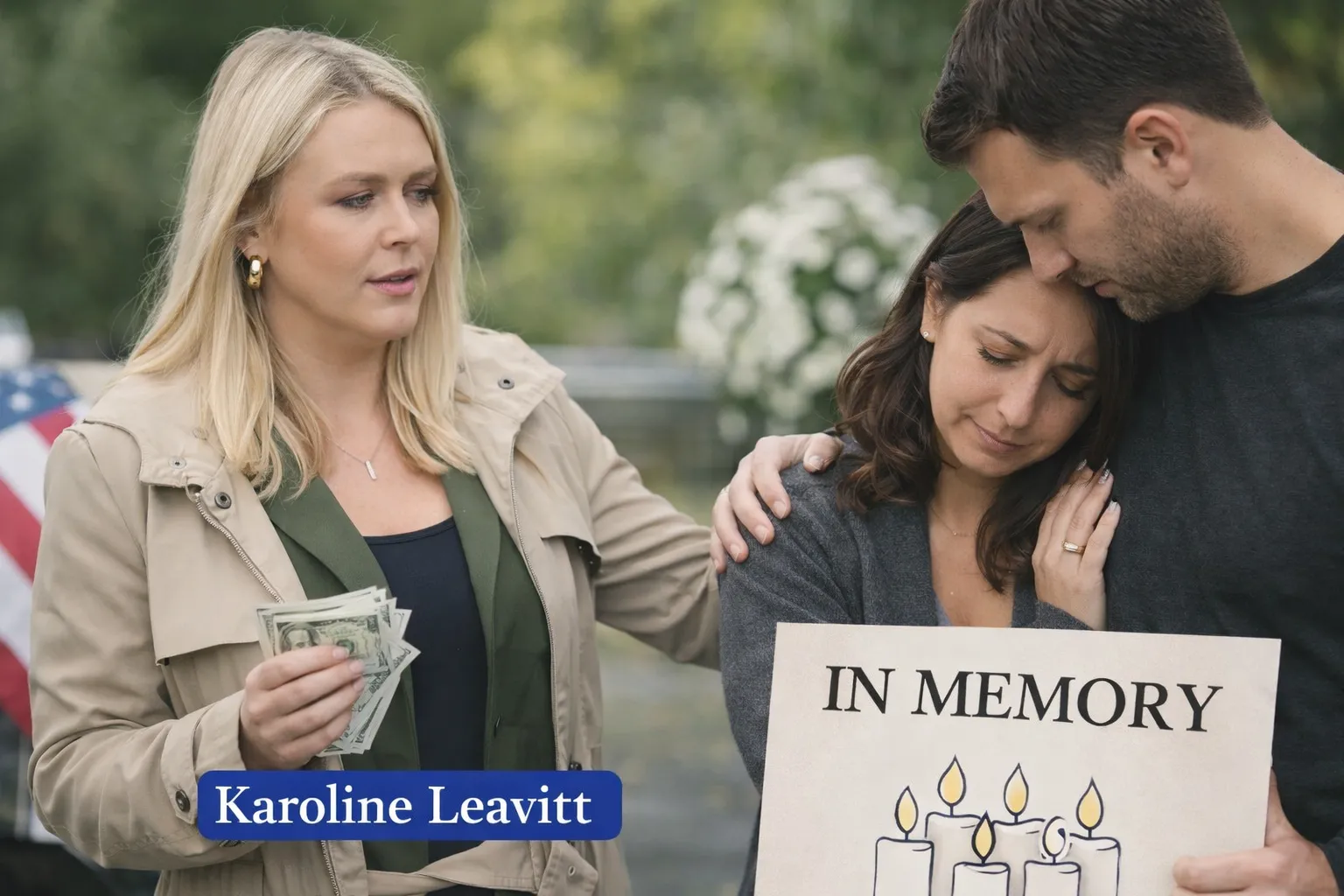
According to reports from WSOC-TV, Karoline Leavitt allegedly stepped forward without publicity, paying funeral costs and sending private financial support to victims’ families through silent, unmarked envelopes.
There were no press releases, no emotional podium speeches, no social media posts demanding praise, only an action that feels strangely out of place in an era addicted to visibility.
In a culture where generosity is often filmed, filtered, and monetized, this alleged silence has proven more explosive than any public declaration could have been.
Supporters describe the act as deeply human, almost old-fashioned, arguing that true compassion does not seek applause or trending hashtags.

Critics, however, are asking harder questions, wondering why such a significant intervention happened privately, and whether silence itself can be a strategic form of power.
Social media feeds are now crowded with speculation, theories, and emotional debates, each one attempting to decode meaning from what was not said.
Why would a public figure choose anonymity in a moment that could easily amplify their personal brand and political relevance.
Is this the rare example of genuine empathy, or is it a carefully calculated absence designed to provoke precisely this level of attention.
Some commentators argue that restraint itself has become a rhetorical weapon, transforming an act of charity into a national psychological mirror.
Others insist that questioning generosity reveals more about modern cynicism than about the individual who chose to act quietly.
Families affected by the crash have largely remained silent, honoring privacy while privately acknowledging support that arrived without explanation or obligation.
That silence, shared by both giver and recipients, has only intensified public curiosity and emotional engagement.
In an age of performative outrage and performative kindness, silence has become the most disruptive message of all.
Online debates now frame this moment as a referendum on authenticity, asking whether true moral action can survive public scrutiny.
For some, Karoline Leavitt’s alleged decision represents a rebellion against digital narcissism and transactional empathy.
For others, it raises uncomfortable questions about influence, power, and what remains unseen when cameras are turned away.
Political analysts are split, with some praising the restraint as statesmanship, while others warn that ambiguity invites mythmaking and manipulation.
The lack of explanation has created a vacuum, and as history repeatedly shows, vacuums are quickly filled with narratives, fears, and projections.
Supporters share the story as proof that humanity still exists beneath political divisions and media spectacle.
Detractors share it with suspicion, arguing that silence can shield motives just as easily as it can reflect humility.
The story’s viral momentum now has less to do with money or funerals, and more to do with the psychology of trust in public life.
At its core, the controversy forces society to confront a deeply uncomfortable question about why we struggle to accept goodness without explanation.
Has constant exposure to manipulation trained us to distrust even kindness unless it arrives with transparency and receipts.
The national conversation has quietly shifted from tragedy itself to the meaning of altruism in a hyper-connected world.
Every share, comment, and argument further amplifies the very silence that sparked the debate in the first place.
Ironically, by saying nothing, the act has spoken to millions, exposing fractures in how people interpret morality, power, and intention.
Some argue that the families’ grief should never have become part of a broader cultural argument at all.
Others believe that moments like this reveal more about society than any planned campaign ever could.

Whether admired or questioned, the alleged act has undeniably reshaped public discourse in ways no headline could have predicted.
The truth is, no one outside a small circle truly knows why Karoline Leavitt did what she did, or even how she understands it herself.
What remains is a nation arguing not over facts, but over meaning, intention, and the uncomfortable power of quiet actions.
Perhaps the most unsettling possibility is that there is no hidden agenda, no secret strategy, only a choice made without expectation.
And maybe that idea, more than any conspiracy or explanation, is what makes the silence so impossible for modern society to accept.


